Messages
-
• 7/20/26
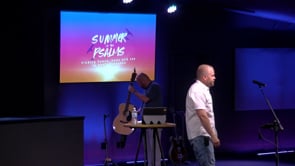
Summer In The Psalms | Week 9 | Danny Cox
This sermon continues the church's "Summer in the Psalms" series by exploring Psalm 118, a psalm centered on God's unchanging love, faithfulness, and trustworthiness. Danny encourages believers to build their lives on Christ—the true cornerstone—rather than on temporary securities like money, success, relationships, or personal control.
-
• 7/13/26
Summer In The Psalms | Week 8 | Jeff Pustelak
This sermon continues the church's "Summer in the Psalms" series, focusing on Psalm 103. Jeff centers the message on God's forgiveness, restoration, and the ongoing spiritual battle every Christian faces. Throughout the sermon, he encourages believers to fight spiritual attacks by preaching God's truth to themselves, just as King David did.
-
• 7/7/26
Summer In The Psalms | Week 7 | Danny Cox
This sermon continues the church's "Summer in the Psalms" series by focusing on corporate worship, drawing primarily from Psalms 95 and 100. Danny challenges us to move beyond simply attending church services and instead become active, joyful worshippers whose praise is centered on God rather than personal preferences.
-
• 6/30/26
Summer In The Psalms | Week 6 | Danny Cox
This week's sermon examines Psalms 61 and 62 and asks a question many people eventually face:
What do you do when life feels like too much?
Danny begins by describing seasons where problems don't come one at a time—they pile on all at once. Work stress, family struggles, financial pressure, health concerns, broken relationships, and spiritual exhaustion can leave people feeling overwhelmed. He explains that the word overwhelmed literally means to be buried beneath, and reminds listeners that God never intended people to carry those burdens alone.
Being overwhelmed is not a sign of weak faith. God invites people to stop carrying burdens they were never meant to bear, run to Him instead of away from Him, rest in His strength rather than their own, and trust that His faithfulness is greater than whatever currently feels overwhelming.
-
• 6/22/26
Summer In The Psalms | Week 5 | Danny Cox
This Father's Day sermon centers on Psalm 46 and tackles a question everyone faces: What do we do when life feels completely out of control? Pastor Danny begins by reflecting on fatherhood, explaining that many dads want to be the source of security, protection, and stability for their families. However, every father eventually discovers a humbling truth: he cannot protect his family from everything. The good news is that God never intended earthly fathers to be the ultimate refuge. Instead, fathers are called to point their families toward the perfect Heavenly Father, who never fails and never loses control. The sermon then explores Psalm 46, which declares that "God is our refuge and strength, an ever-present help in trouble." The emphasis is that trouble is not a possibility—it is a certainty. The question is not whether storms will come, but where people will run when they do. A significant section of the sermon focuses on God's presence. The "river" described in Psalm 46 symbolizes God's sustaining presence among His people. The pastor argues that God's greatest gift is not always immediate rescue from hardship but His presence during hardship. Sometimes God calms the storm; other times He walks with people through it, using trials to strengthen their faith and shape their character. The sermon then transitions to the Gospel. Humanity's problem is sin, which separates people from God. Jesus came to solve that problem through His death and resurrection, making it possible for people to be restored to a relationship with God and experience His presence through the Holy Spirit. Toward the end, the pastor focuses on the famous phrase: "Be still and know that I am God." He challenges a common interpretation that views this only as quiet meditation. Instead, he argues that the phrase is more like God saying: Stop striving. Stop trying to control everything. Stop carrying burdens you were never meant to carry. Trust that God is still in control. The sermon concludes by noting that, although the chaos described in Psalm 46 never actually disappears, the perspective changes. The mountains are still shaking, nations are still raging, and uncertainty remains. The difference is that God's presence remains as well. Life will always contain chaos, suffering, and uncertainty, but believers do not find safety in controlling their circumstances. They find safety in trusting a God who is present, sovereign, and unshaken by anything happening in the world.
-
• 6/16/26
Summer In The Psalms | Week 4 | Danny Cox
This sermon explores one of the biggest questions people ask about faith:
"Does God actually hear my prayers?"
Using Psalm 34, Danny explains that David wrote this psalm during one of the darkest moments of his life. He was running from King Saul, hiding among his enemies, and was so desperate that he pretended to be insane to survive. Yet after God rescued him, David's response was praise.
The message emphasizes that praising God isn't reserved for when life is easy. David says he will praise God "at all times," meaning even in fear, confusion, and suffering. The pastor points out that God doesn't always remove our problems, but He often removes the fear that controls us.
A major theme is that fear causes isolation. When anxiety and hardships come, people tend to pull away from others and from God. Instead, the pastor encourages listeners to bring everything to God in prayer because He listens, cares, and invites people to seek refuge in Him.
The sermon then centers on Psalm 34's famous invitation to "taste and see that the Lord is good." Christianity is presented as more than simply knowing facts about God—it's an invitation to experience Him personally. The pastor uses an illustration of tasting honey after months without sweets to show that no description can replace personal experience.
Another key point is that God is especially near to the brokenhearted and those crushed in spirit. Pain and suffering are not signs that God has abandoned someone. In fact, some of the deepest experiences of God's presence happen in life's valleys.
The sermon ultimately points to Jesus. Jesus experienced grief, rejection, betrayal, and suffering, so believers are praying to a Savior who truly understands pain. Through His death and resurrection, Jesus made it possible for people to approach God confidently and personally.
God hears every cry, invites people to seek Him personally, stays close in suffering, and can be trusted even when prayers seem unanswered or life doesn't make sense.
-
• 6/6/26
Summer In The Psalms | Week 2 | Danny Cox
This episode centers on one of the most beloved passages in scripture—Psalm 23—but it quickly becomes clear that this isn’t a message about funerals, loss, or comforting words for difficult moments.
It’s a message about who is leading your life right now.
The entire episode revolves around one powerful declaration:
“The Lord is my Shepherd.”
Not a shepherd.
My Shepherd.
And that single word changes everything.
Danny argues that most people spend their lives looking for peace, security, identity, purpose, and fulfillment in things that were never designed to carry that weight. Success becomes our shepherd. Approval becomes our shepherd. Money becomes our shepherd. Control becomes our shepherd.
But every one of those eventually fails.
Because according to the message:
Anything you look to for ultimate peace besides God becomes a terrible shepherd.
The episode ends with a deeply personal challenge:
Are you still carrying burdens that the Shepherd has already offered to carry?
Are you trying to lead yourself?
Or are you willing to trust the One who has never abandoned His flock?
Because according to Psalm 23, the greatest promise isn’t that life will become easy.
It’s that no matter where the path leads—
The Shepherd is already there.
-
• 5/26/26
Summer In The Psalms | Week 1 | Danny Cox
This episode starts with a deceptively simple question:
What are you building your life on?
At first, it sounds like another conversation about habits or faith. But as the message unfolds through Psalm 1, it becomes something much more confronting:
Everyone is rooted in something.
The real question isn’t if you’re rooted—it’s what your roots are attached to.
Career. Success. Comfort. Politics. Entertainment. Relationships. Fear. Approval.
The episode argues that whatever consistently shapes you… eventually forms you.
The goal isn’t occasional inspiration.
The goal is deep roots.
The diagnosis is blunt:
You cannot expect spiritual stability with shallow spiritual roots.
Everything points back to Jesus through the Gospel of John 15:
“I am the vine… you are the branches.”
The argument becomes clear:
Fruit isn’t manufactured.
Fruit is produced through connection.
Connection to Christ.
Connection to scripture.
Connection to community.
The episode closes with a deeply personal challenge:
What voices shape you most?
What consumes your attention?
What are your roots actually attached to?
Because according to Psalm 1:
The storms are coming either way.
And when they arrive…
Your roots will determine your fruit.